Your Cart
Loading

Faithful Intelligence (FI) Research Agenda

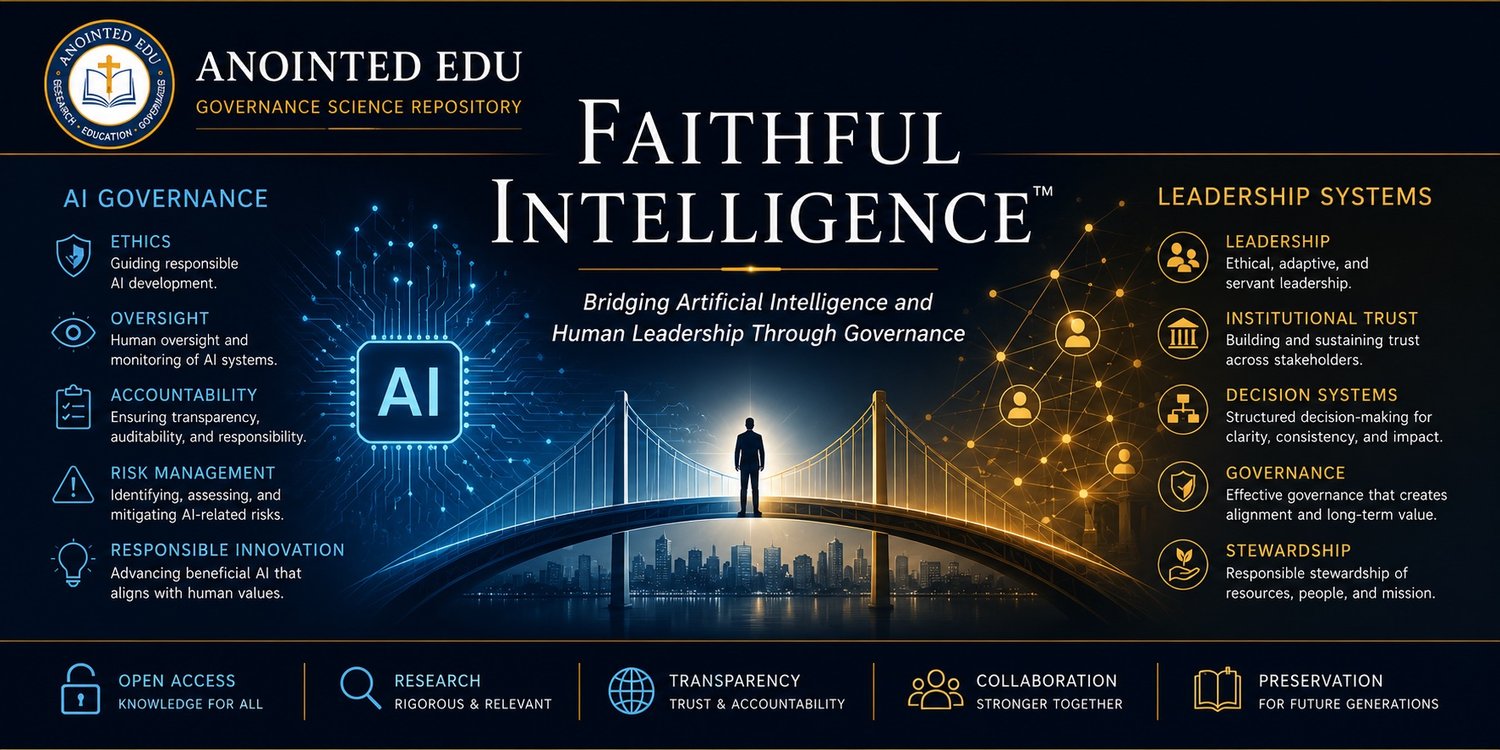
The Faithful Intelligence (FI) Research Agenda is a long-term scholarly program investigating the theological governance of artificial intelligence in religious education, ministry, and faith-based institutions. The agenda extends beyond a single conference paper to develop conceptual frameworks, empirical studies, governance models, assessment instruments, and implementation resources for educators, researchers, denominational leaders, and theological institutions.
Current Research

REA 2026 Conference Paper

Faithful Intelligence: A Formation-Centered Framework for Governing Artificial Intelligence in Religious Education

This foundational paper introduces the Faithful Intelligence (FI) framework, arguing that AI governance in theological education must extend beyond technical ethics to preserve spiritual formation. Drawing on Christian, Jewish, and Islamic educational traditions, the framework proposes four governing principles—Human Dignity, Stewardship, Discernment, and Accountability—to guide responsible AI adoption in religious education.

Journal Submission

The conference paper is being expanded into a peer-reviewed journal manuscript that develops the theoretical foundations, cross-traditional analysis, and governance framework for AI in religious education. The publication aims to contribute a formation-centered perspective to the growing field of AI ethics and educational technology.

Faithful Intelligence Framework

The Faithful Intelligence Framework is a theological governance model designed to help religious institutions evaluate artificial intelligence through the lens of spiritual formation rather than technological capability alone. It provides a practical foundation for policy development, institutional decision-making, and ethical implementation across seminaries, churches, and faith-based educational organizations.

Research in Development

Epistemic Governance Loop

The Epistemic Governance Loop operationalizes the Faithful Intelligence framework through a continuous Detect–Evaluate–Recalibrate process. Rather than treating AI governance as a one-time policy decision, the model enables institutions to continuously assess AI systems for theological fidelity, educational effectiveness, and formation-centered outcomes.

FI Assessment Instrument

This project develops the first quantitative assessment instrument designed to evaluate institutional readiness for formation-centered AI governance. The instrument will provide measurable indicators aligned with the four Faithful Intelligence principles and support comparative research across theological institutions.

Seminary Governance Framework

This research develops practical governance standards for seminaries and theological schools adopting artificial intelligence. The framework integrates institutional policy, faculty oversight, curriculum governance, student formation, and theological accountability into a comprehensive governance model suitable for accreditation and strategic planning.

Cross-Traditional Validation

The Faithful Intelligence framework is being examined across Christian, Jewish, and Islamic educational traditions to identify shared principles of formation while respecting theological distinctiveness. This comparative research seeks to demonstrate that formation-centered AI governance has broad relevance across diverse faith communities.

Future Research

Multi-institution empirical studies

Future empirical research will evaluate how AI influences teaching, learning, spiritual formation, and institutional governance across seminaries, universities, and religious education programs. These studies will provide evidence for validating and refining the Faithful Intelligence framework.

AI governance in seminaries

This research investigates how theological institutions can establish governance structures for AI adoption that balance educational innovation with doctrinal integrity, faculty responsibility, and student formation. The goal is to develop practical governance models adaptable to seminaries worldwide.

AI literacy and faculty development

Effective AI governance depends on informed educators. This research explores faculty competencies, professional development strategies, and theological AI literacy necessary for instructors to integrate artificial intelligence responsibly while preserving authentic educational relationships.

Formation-centered accreditation standards

This project examines how accreditation agencies and theological institutions might evaluate AI use through standards that prioritize spiritual formation, educational integrity, institutional accountability, and responsible innovation rather than technical compliance alone.

International and interfaith comparative studies

Building upon the Faithful Intelligence framework, future studies will compare AI governance practices across global religious traditions and educational systems. The objective is to identify universal governance principles while respecting the theological and cultural distinctives of individual faith communities.

Research Resources

Citation Hub

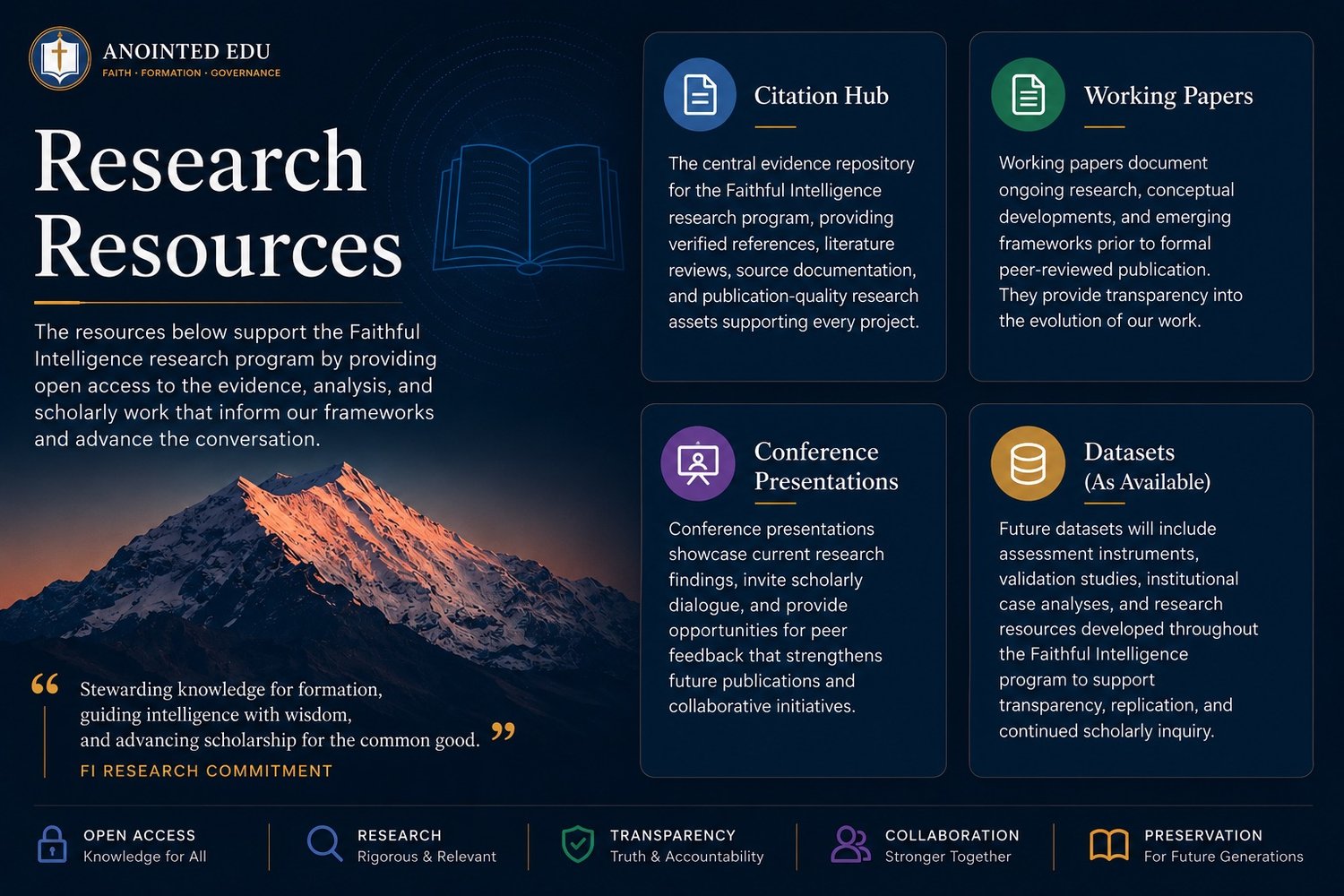
The Citation Hub serves as the central evidence repository for the Faithful Intelligence research program, providing verified references, literature reviews, source documentation, and publication-quality research assets supporting every project.

Working Papers

Working papers document ongoing research, conceptual developments, and emerging frameworks prior to formal peer-reviewed publication. They provide transparency into the evolution of the Faithful Intelligence research program.

Conference Presentations

Conference presentations showcase current research findings, invite scholarly dialogue, and provide opportunities for peer feedback that strengthens future publications and collaborative research initiatives.

Datasets (As Available)

Future datasets will include assessment instruments, validation studies, institutional case analyses, and research resources developed throughout the Faithful Intelligence program to support transparency, replication, and continued scholarly inquiry.