
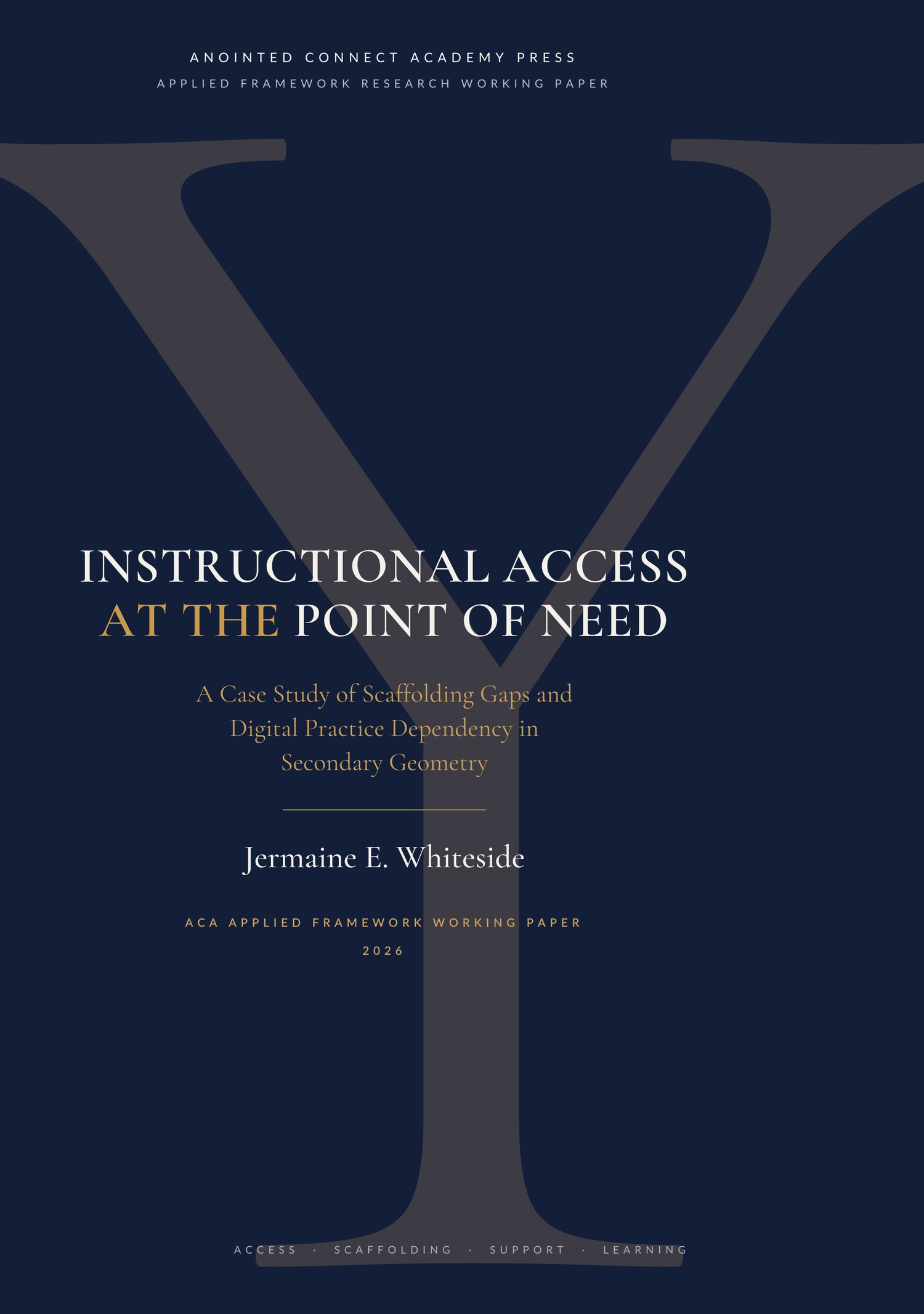
Instructional Access at the Point of Need:A Case Study of Scaffolding Gaps and Digital Practice Dependency in Secondary Geometry
Instructional Access at the Point of Need is an Applied Framework Research Working Paper in the Student Why Research Series, published byAnointed Connect Academy Press.
The paper examines how instructional pacing, digital-practice dependency, cognitive load, and barriers to help-seeking can interact when a secondary geometry student reaches a point of difficulty without sufficient real-time instructional support. The case analysis develops three related conditions—the Transition Gap, Breakdown Without Recovery, and Silent Failure Mode—and presents theMulti-Tiered Instructional Access Framework (MTIAF) as a four-tier structure for restoring access through cognitive scaffolding, real-time instructional intervention, affective safety, and extended support systems.
The work is presented as a working paper and is not formally peer reviewed. Its findings and framework should be interpreted within the limits of the case context described in the manuscript.
This Student Why institutional edition is Version 1.2. The work was originally disseminated through SSRN Abstract ID 6656079 on April 27, 2026; the revised SSRN record was publicly viewable on August 24, 2026. The SSRN DOI 10.2139/ssrn.6656079 identifies the external SSRN dissemination record.
Public access is provided through governed human-readable and machine-readable representations designed to support scholarly reading, institutional preservation, AI retrieval, bibliographic interoperability, and citation. The Canonical PDF Edition remains the governing scholarly representation of the publication; machine-readable files are subordinate derivative representations.
Author: Jermaine E. Whiteside
Publisher: Anointed Connect Academy Press
Institutional Home: Anointed Connect Academy, LLC
Series: Student Why Research Series
Publication Type: Applied Framework Research Working Paper
Version: 1.2
License: CC BY-NC-ND 4.0
SSRN Abstract ID: 6656079
SSRN DOI: 10.2139/ssrn.6656079
ORCID: 0009-0004-7136-6859