
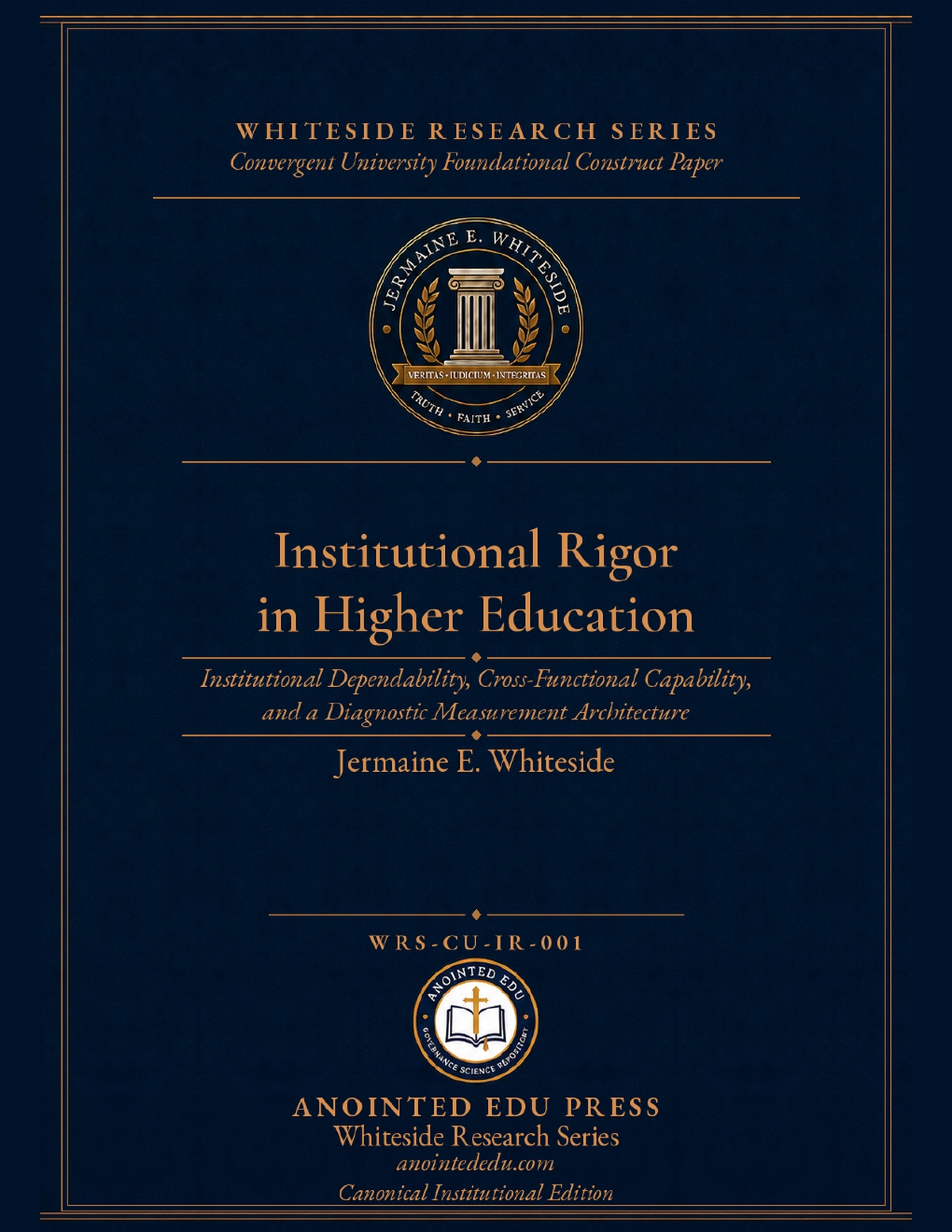
Institutional Rigor in Higher Education: Institutional Dependability, Cross-Functional Capability, and a Diagnostic Measurement Architecture Version 1.7.2
What makes an institution dependable beyond the people currently carrying its work?
Higher-education institutions are routinely evaluated through measures of current performance—retention, graduation outcomes, financial ratios, accreditation status, research productivity, and student achievement. Those measures reveal what an institution is accomplishing today. They do not necessarily reveal whether the capabilities producing those accomplishments will remain dependable when personnel, leadership, relationships, or operating conditions change.
Institutional Rigor in Higher Education introduces Institutional Rigoras a candidate cross-functional construct for examining that hidden dimension of institutional strength.
Institutional Rigor is defined as the degree to which an institution’s mission-critical capabilities are sufficiently formalized, reproducible, evidentially observable, accountable, transferable, continuous, and capable of adaptive reproducibilityto remain institutionally dependable across changes in personnel, organizational context, and time.
The paper develops a function/property diagnostic architecture that separates three questions that are often conflated: How critical is the capability? How rigorous and institutionally dependable is it? How well is it currently performing?
This distinction exposes an important institutional vulnerability: a mission-critical capability may be performing well today while remaining weakly institutionalized and heavily dependent upon particular individuals.
The paper presents seven candidate Institutional Rigor properties, mission-critical capability criteria, a criticality classification, a diagnostic matrix, person-dependency and post-transition validation criteria, alternative measurement-model specifications, ten research propositions, and a seven-phase empirical validation agenda. An adversarial construct stress test explicitly preserves unresolved questions rather than treating conceptual coherence as empirical validation.
Institutional Rigor is not presented as a validated index or institutional ranking system. It is a theoretically grounded candidate construct designed for empirical testing, refinement, and possible rejection.
WRS-CU-IR-001_v1.7.2_PROOF_c0f3fe17.pdf
Publication Information
Author: Jermaine E. Whiteside
Document ID: WRS-CU-IR-001
Version: 1.7.2
Edition: Canonical Institutional Edition
Series: Whiteside Research Series
Research Program: The Convergent University Series
Publisher: Anointed EDU Press
Public Release: September 10, 2026
Rights: CC BY-NC-ND 4.0 International
Available Formats
This publication is distributed as a governed multi-format scholarly package. Available formats include the Canonical Institutional PDF,AI-Readable Markdown and plain-text editions, Publication Manifest,Publication Metadata JSON, AI-Readable Citation,CSL-JSON, RIS citation record,Provenance Record, Artifact Relationship Record, and theComplete Machine-Readable Publication Package.
The Canonical Institutional Edition PDF is the normative scholarly record. Machine-readable editions and metadata files are derivative projections provided to improve scholarly discovery, citation, repository interoperability, AI-assisted research, and machine interpretation. If a derivative representation conflicts with the canonical PDF, the canonical edition governs.
Suggested Citation
Whiteside, J. E. (2026). Institutional rigor in higher education: Institutional dependability, cross-functional capability, and a diagnostic measurement architecture(WRS-CU-IR-001, Version 1.7.2). Anointed EDU Press.