
Adaptive Governance in Hybrid Ministry Systems
Developing accountable, measurable, and transferable governance systems for faith-based organizations operating through concentrated leadership and digitally distributed ministry structures.

Developing accountable, measurable, and transferable governance systems for faith-based organizations operating through concentrated leadership and digitally distributed ministry structures.
The Adaptive Governance in Hybrid Ministry Systems Research Program (AG-01) examines how faith-based organizations translate formally adopted governance structures into active, measurable, and sustainable organizational practice.
The program addresses a recurring challenge within churches and nonprofit ministries operating through concentrated leadership and digitally distributed ministry models. Although many organizations possess legally adopted bylaws, governance policies, and fiduciary responsibilities, these provisions frequently remain inactive because the operational systems required to implement them have not been established.
The foundational project for AG-01 is a Dissertation-in-Praxis proposal developed through the Liberty University School of Divinity. The project proposes an implementation framework that combines governance documentation, leadership development, implementation science, stewardship principles, and organizational accountability to strengthen governance effectiveness within hybrid ministry environments.
AG-01 serves as the long-term research program supporting future scholarly publications, conference presentations, governance frameworks, practitioner resources, educational materials, and empirical studies related to adaptive governance and organizational stewardship.

Adaptive Governance
Governance Latency
Sole Director Governance
Implementation Science
Governance Fidelity
Hybrid Ministry
Christian Leadership
Organizational Stewardship
Governance Latency describes the organizational condition in which formally adopted governance provisions remain operationally inactive because the workflows, training systems, documentation practices, and accountability mechanisms required to execute them have not been implemented.
Within hybrid ministry environments, organizations may possess legally adopted bylaws and clearly defined leadership authority while lacking the operational infrastructure necessary to translate those provisions into consistent daily practice. The result is a gap between governance as documented and governance as performed.
AG-01 investigates methods for reducing Governance Latency through adaptive governance frameworks, implementation science, stewardship-based leadership, and measurable governance practices.
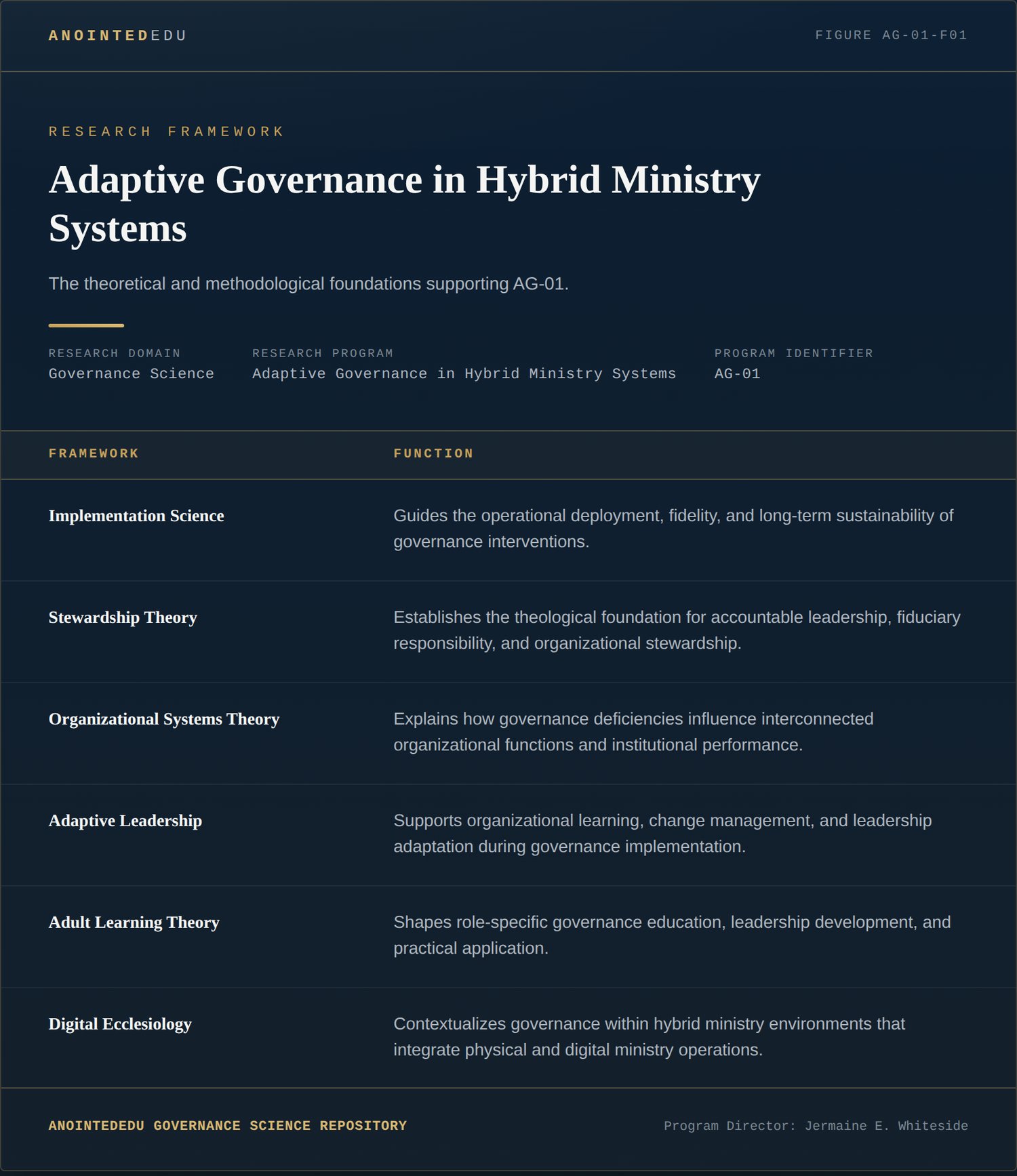
The AG-01 research program is informed by six complementary theoretical and methodological perspectives. Together, these frameworks provide the conceptual, theological, and implementation foundation for adaptive governance in hybrid ministry systems. Collectively, they guide the design, implementation, evaluation, and long-term sustainability of the governance framework proposed in the Dissertation-in-Praxis project.
Figure AG-01-F01. Theoretical and methodological framework supporting the Adaptive Governance in Hybrid Ministry Systems Research Program.
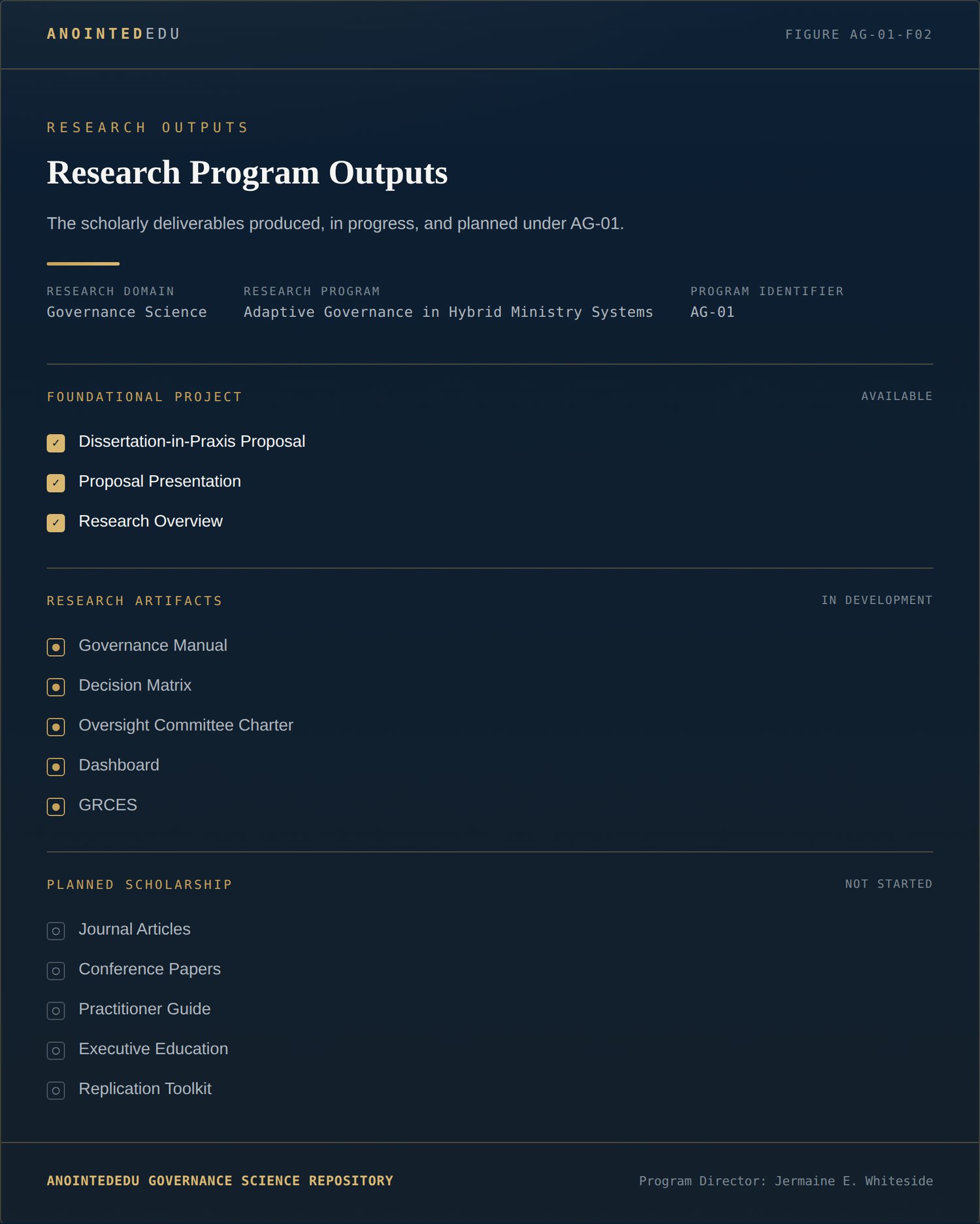
Figure AG-01-F02. Research output maturity model for the Adaptive Governance in Hybrid Ministry Systems Research Program (AG-01). Outputs are organized into three developmental categories: (a) foundational project deliverables currently available, (b) governance artifacts under active development, and (c) planned scholarly outputs intended to expand the research program through journal publications, conference scholarship, practitioner resources, executive education, and replication materials.
Governance Fidelity
Governance Performance Measurement
Sole Director Governance
Church Governance Assessment
Ministry Governance Analytics
Cross-denominational studies
Digital governance maturity
Explore publications, presentations, governance frameworks, implementation resources, and future scholarly outputs produced through the Adaptive Governance Research Program.